
If you are running a business on your own, every single dollar in your bank account has a job. Every hour in your schedule carries a heavy opportunity cost.
For the better part of a decade, the standard blueprint for solopreneurs has been remarkably predictable:
- Build a landing page.
- Fire up Meta Ads Manager or Google Ads.
- Pay per click.
- Pray that your conversion rates clear your cost per acquisition (CPA).
That playbook is breaking down. Customer Acquisition Cost (CAC) on traditional pay-per-click (PPC) and social advertising platforms has skyrocketed. Meta’s ad auction is fiercely competitive, privacy updates (like Apple’s iOS privacy changes) have rendered tracking less effective, and Google Search ads for high-intent keywords can easily cost tens of dollars per single click. For a solo founder operating on tight margins, running paid ads often feels like fueling a high-maintenance engine that stops the exact second you stop feeding it cash.
There is, however, a fundamentally better way to build an audience, generate high-intent leads, and create scalable client acquisition systems without bleeding money into paid ad auctions: YouTube marketing.
YouTube is not just a social video platform; it is the world’s second-largest search engine. When leveraged correctly, YouTube operates like a automated sales team working 24 hours a day, 7 days a week—generating organic traffic, building immediate trust, and driving conversions for years after a single video is published.
- The Paid Ads Trap vs. The Asset Model
To understand why YouTube is the ultimate growth lever for solopreneurs, you must first understand the fundamental flaw of relying exclusively on paid channels like Meta (Facebook/Instagram) or Google PPC.
Paid Ads: Renting Traffic
When you run Facebook or Google Ads, you are renting attention.
Zero Long-Term Value: The moment you pause your daily ad budget, your lead flow vanishes instantly.
Margin Compression: As more competitors bid on the same audience or keywords, ad costs rise. You are forced to pay higher prices for the exact same quality of traffic over time.
Ad Fatigue: A Meta ad creative typically lasts a few days or weeks before performance degrades, forcing you into a non-stop cycle of designing, testing, and rewriting ads.
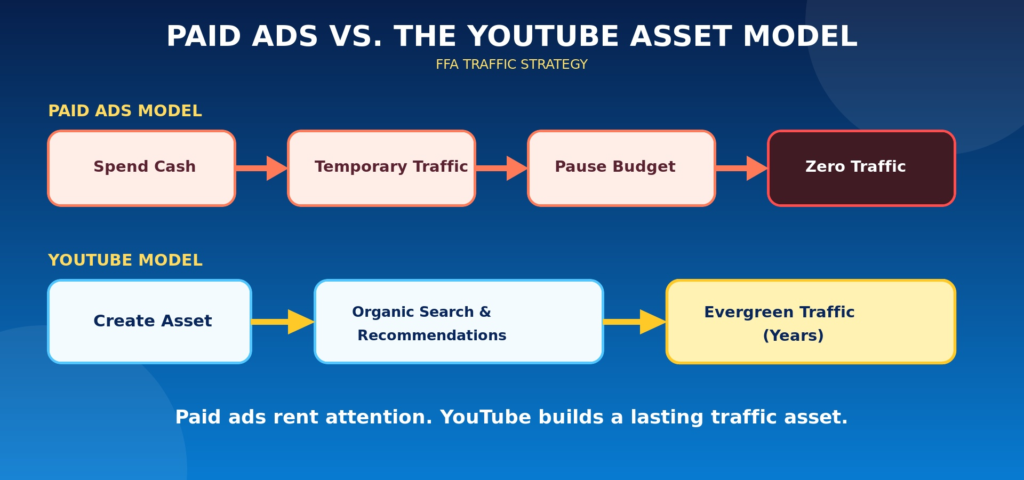
 YouTube Organic: Building Digital Real Estate

YouTube content is an appreciating asset. Unlike a Facebook post with a half-life of 24 hours or a paid ad that expires when your balance hits zero, a well-targeted YouTube video compounds in value over time.

Because YouTube is owned by Google and indexed like a search engine, a video recorded today can rank at the top of search results for specific, high-intent problem queries three years from now. You invest the labor upfront to record and publish the video, and the platform delivers free, highly qualified traffic continuously into your sales funnel.
- Intent vs. Interruption: The Fundamental Shift
The primary reason conversion rates on YouTube traffic routinely outperform standard Facebook ads comes down to user psychology: Search Intent vs. Feed Interruption.
Meta Ads: Interruption Marketing
When someone is scrolling through Instagram or Facebook, they are looking for entertainment, social connection, or dopamine. Your ad interrupts their experience. You have a split second to grab their attention, convince them they have a problem, and persuade them to leave their feed to click your link. You are fighting uphill against low intent.
YouTube: Problem-Solving Intent
YouTube users are frequently actively seeking a solution. They open the platform and type queries into the search bar like:
“How to automate Instagram lead generation”
“Best accounting software for single-member LLCs”
“How to format a book for Amazon KDP”
When your video answers that exact query, you are not interrupting them; you are delivering the precise solution they asked to find. The user is primed to listen, take action, and trust the source that provided the answer.
- Micro-Targeting High-Intent Audiences Without an Ad Budget
Google Ads charges a steep premium to place your link at the top of high-intent search queries. YouTube allows you to capture that exact same high-intent audience organically by targeting long-tail search keywords.
As a solopreneur, you don’t need millions of casual views to build a profitable business. You only need a few hundred viewings from the right people—prospects who are actively trying to solve the problem your product or service addresses.
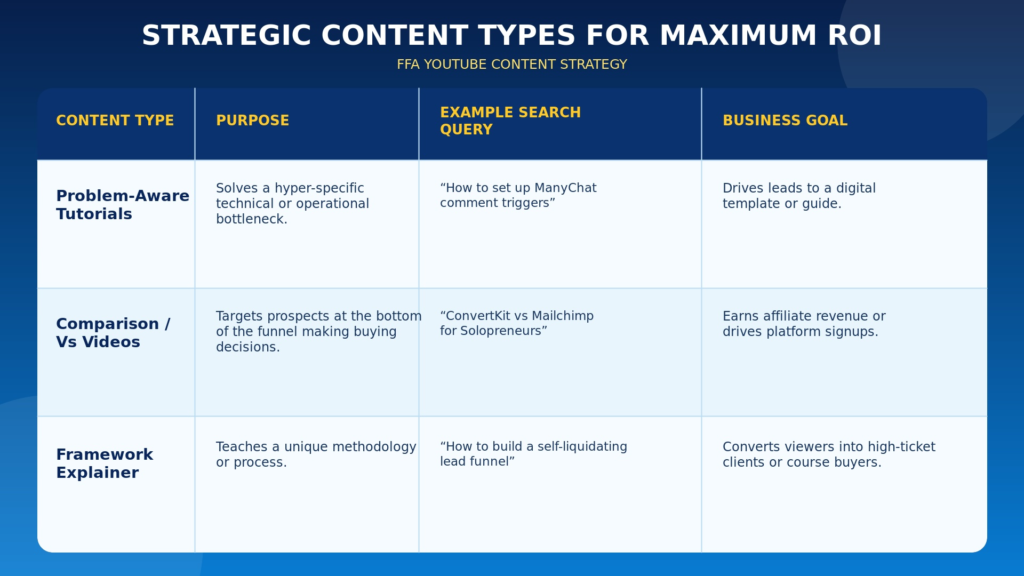
By building a media library around these hyper-focused topics, you effectively rank for key industry terms without spending a dime on search bidding wars.
- The Parasitic Trust Engine: Accelerated Sales Cycles
Trust is the central currency of online business. For a solo entrepreneur without a massive corporate brand name, convincing a complete stranger to open their wallet requires overcoming significant skepticism.
On traditional landing pages driven by cold Facebook ads, you have to build trust through static copy, testimonials, and high-pressure sales tactics. On YouTube, trust is built naturally through video intimacy.
Key Takeaway: When a prospect watches a 10-to-15-minute video where you teach a concept clearly, demonstrate your expertise on screen, and solve a genuine problem, they build a personal connection with you.
By the time a viewer clicks the link in your YouTube video description and enters your email funnel or books a call, they are no longer a “cold lead.” They already know your voice, respect your knowledge, and trust your methodology. This dramatically reduces your sales cycle:
Fewer objections on discovery calls or sales pages.
Higher conversion rates on your email sequences.
Lower churn because clients know exactly who they are working with.
You achieve with 15 minutes of organic video content what would otherwise cost thousands of dollars in retargeting ads and nurture campaigns.
- Converting Viewers into Owned Assets (The Organic Funnel)
A common mistake solopreneurs make is treating YouTube like a social media platform focused solely on subscriber counts or ad revenue (AdSense). For a business owner, subscribers are a vanity metric; email subscribers and sales are bankable assets.
To replace paid ads with YouTube, you must build a clear bridge from your free video content to an owned audience asset (your email list).
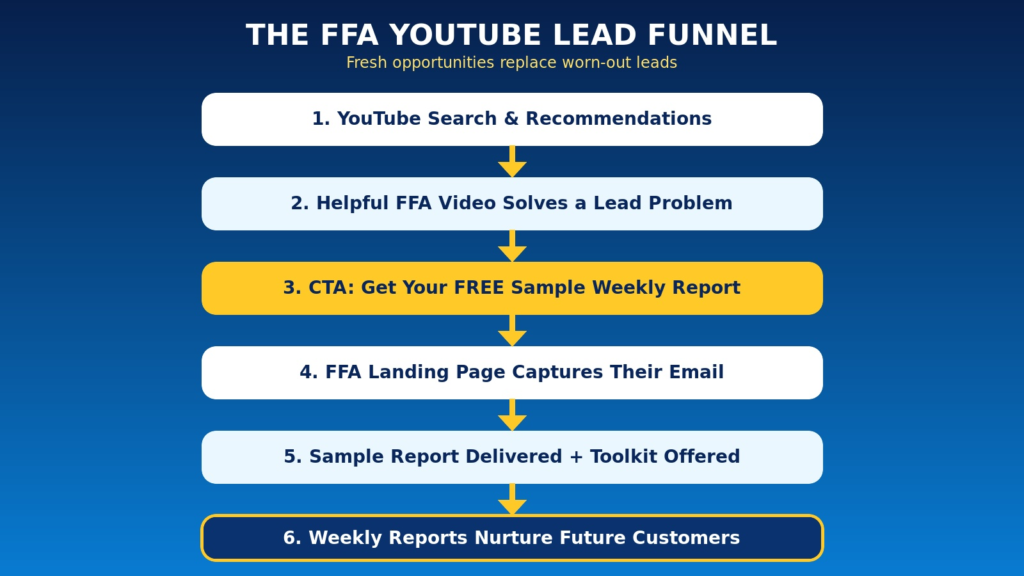
Blueprint for an Effective Video Lead Funnel:
- Solve 80% of the Problem in the Video: Deliver massive, actionable value on screen. Don’t hold back the core secret; give away the step-by-step process.
- Offer the Shortcut as a Free Resource (Lead Magnet): The remaining 20% should be the tool that saves time—a free template, checklist, cheat sheet, or code script.
- Dedicated Pin & Description Links: Place the link to your free resource at the top of the video description and pin it as the first comment.
- On-Screen Call to Action: Verbally tell the viewer exact value they get by clicking the link in the description to grab the resource.
- Play the Long Game: Compounding Returns
When you spend $1,000 on Facebook Ads, that budget is consumed immediately. If it generates $1,500 in sales, you made a profit, but you must immediately reinvest another $1,000 to keep the machine running.
YouTube works on compounding interest.
Month 1: You publish 4 targeted videos. They receive a modest 200 views each (800 total views). You collect 30 email leads.
Month 6: You have 24 videos published. Your older videos are now being recommended by YouTube’s algorithm and indexed by Google Search. Your channel generates 5,000 views per month passively, producing 200+ email leads every single month without extra labor.
Year 2: Your library of 50+ videos acts as an army of automated salespeople. They drive predictable, organic lead flow day in and day out while you focus entirely on product creation, strategy, and fulfillment.
The Verdict: Reclaim Your Profit Margins
For the solopreneur, paid advertising on Meta and Google is increasingly becoming a high-risk game reserved for venture-backed companies or brands with massive budgets to burn on testing.
YouTube offers a modern alternative: Swap ad spend for content equity.
By creating simple, direct, problem-solving videos aimed at your target customer, you stop renting attention and start owning media assets. You bypass skyrocketing ad auctions, cultivate deep trust with prospective buyers, and construct a long-term engine for recurring sales and low-cost lead generation.
Stop funding the ad networks’ margins at the expense of your own. Start building your organic YouTube engine today.