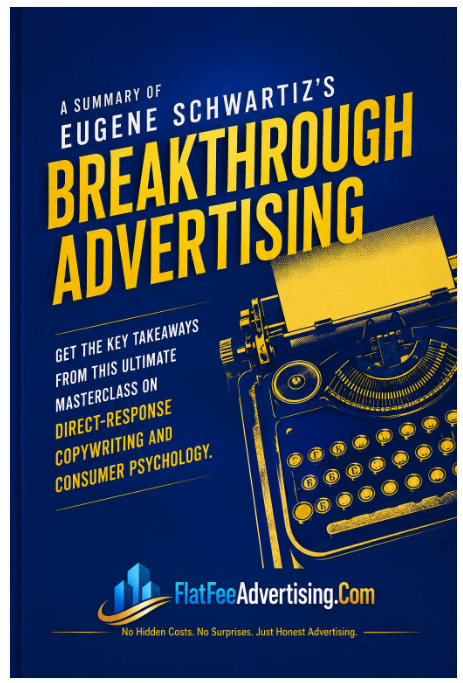
In the world of direct-response marketing and copywriting, few names evoke as much reverence as Eugene Schwartz. Operating during the mid-20th-century golden age of advertising, Schwartz generated hundreds of millions of dollars in sales for his clients using nothing more than a typewriter, a deep understanding of human psychology, and an unmatched strategic discipline.
While many of his mid-century peers relied on gut instinct or decorative creativity, Schwartz approached advertising as a science of market diagnosis. In 1966, he published his masterwork, Breakthrough Advertising. Decades later, the book is widely regarded by top performance marketers, agency founders, and copywriters as the definitive textbook on marketing strategy, buyer psychology, and message positioning.
The Power of Breakthrough Advertising
What makes Breakthrough Advertising unique is that it is not merely a book about writing clever headlines or catchy slogans. Instead, it teaches marketers how to diagnose market conditions before a single word of copy is written.
Schwartz introduced several ground-breaking concepts that fundamentally changed how businesses communicate with potential customers:
1. Copy Does Not Create Desire—It Channels It
One of Schwartz’s core tenets is that advertising cannot manufacture human desire out of thin air. Attempting to force an audience to care about something they have no appetite for is the single fastest way to fail. Instead, the copywriter’s job is to identify the deep-seated hopes, fears, dreams, and primal desires that already exist within a market and channel that energy toward a specific product or solution.
2. The 5 Stages of Customer Awareness
Schwartz recognized that every prospect sits at a specific level of awareness regarding their problems and potential solutions. He mapped these into five distinct stages:
- Unaware: The prospect feels symptoms but hasn’t named the underlying problem.
- Problem-Aware: The prospect recognizes their pain point but doesn’t know solutions exist.
- Solution-Aware: The prospect knows solutions exist but isn’t familiar with your specific brand.
- Product-Aware: The prospect knows your product but hasn’t decided to buy yet.
- Most Aware: The prospect knows your brand, trusts it, and simply needs a compelling offer or deal to act.
Matching your marketing message directly to the audience’s state of awareness determines whether an ad campaign succeeds or dies.
3. The 5 Stages of Market Sophistication
Alongside customer awareness, Schwartz outlined market sophistication—the measure of how many competing promises a market has already heard in a given category. As a market matures and competitors make increasingly bold claims, buyers become skeptical. Marketers must adapt their strategy—moving from simple claims to expanded promises, introducing a “unique mechanism” (the scientific or logical reason why the product works), and eventually shifting to identification and storytelling.
Why Schwartz’s Concepts Are More Relevant Today Than Ever
Although Breakthrough Advertising was written long before the advent of the internet, social media algorithms, or digital sales funnels, its principles have grown more valuable in the modern digital economy.
- Algorithmic Targeting and Awareness: Modern ad platforms like Meta, TikTok, and YouTube rely on creative-led targeting. The first few seconds of a video ad or the hook of a headline dictate who the platform shows your ad to. Schwartz’s framework for matching the hook to the prospect’s exact level of awareness is precisely how modern direct-to-consumer brands write high-converting digital ads.
- Hyper-Saturated Markets: Today’s consumer is bombarded with thousands of marketing messages daily. Most markets operate at Stage 4 or Stage 5 sophistication, where standard “big promises” no longer work. Marketers who understand Schwartz’s concept of the “unique mechanism” can effortlessly differentiate their product in crowded niches where competitors struggle with rising customer acquisition costs.
- Timeless Human Psychology: Technology, communication channels, and ad formats constantly evolve, but fundamental human psychology remains unchanged. Schwartz’s insights tap into permanent psychological drivers—fear, status, convenience, security, and pride—ensuring his strategies remain effective regardless of medium.
The $300 Barrier—And How to Bypass It
Because of its legendary status and the invaluable strategic competitive advantage it offers, Breakthrough Advertising has long been treated as a prized possession among high-earning marketers and entrepreneurs. Out-of-print physical copies regularly sell on secondary markets for $300 (USD) or more, with collector editions fetching even higher prices.
While the original full-length text remains a dense, highly detailed read filled with mid-20th-century print examples, the core strategic frameworks can be understood and applied quickly.
For entrepreneurs, copywriters, and business owners looking to master these concepts without tracking down a $300 collector’s volume, a simplified breakdown is available.
Master Eugene Schwartz’s Strategy Today
You don’t need to spend hundreds of dollars or wade through hundreds of pages of complex mid-century jargon to start using these game-changing principles in your own business.
Click Here to Get the Simplified Summary of Eugene Schwartz’s Breakthrough Advertising