
The Wall Street Journal article highlights how artificial intelligence is enabling a surge of high-revenue, single-person startups that operate without traditional employees.
AI as the Back-Office Engine: Founders leverage generative AI and autonomous agents to automate tasks across soft software engineering, customer service, email responses, marketing, and operational troubleshooting, allowing one person to manage the workload of an entire team.
Explosive Revenue Growth: Data from payment platform Stripe shows a sharp rise in solo entrepreneurs crossing major financial milestones—the number of one-person businesses generating over $1 million annually doubled, while those reaching over $10 million nearly tripled.
Shift in Macro Trends: U.S. Census Bureau data indicates a ~45% surge in new business filings in the information sector. However, a record-low percentage of these applicants report plans to hire employees, signaling a structural shift toward leaner, technology-driven solo ventures.
Venture Capital Efficiency: Solo founders are taking on VC funding to scale tech infrastructure and customer acquisition rather than allocating millions toward labor costs, software engineering salaries, or executive compensation.
Lower Entry Barriers & Modern Friction: While AI dramatically lowers the barrier to launch a product, it creates new challenges: increased market noise, a rise in fast-following copycat products, reliance on AI usage fees, and the ongoing demand to maintain trust and customer relationships alone.
The million-dollar solo businesses profiled in The Wall Street Journal and broader market data operate primarily in high-margin B2B software, specialized automation services, and vertical productivity tools. Rather than attempting to serve consumer broad markets (B2C), these companies focus on high-value corporate pain points where customers are already willing to pay premium recurring subscription or retainer fees.
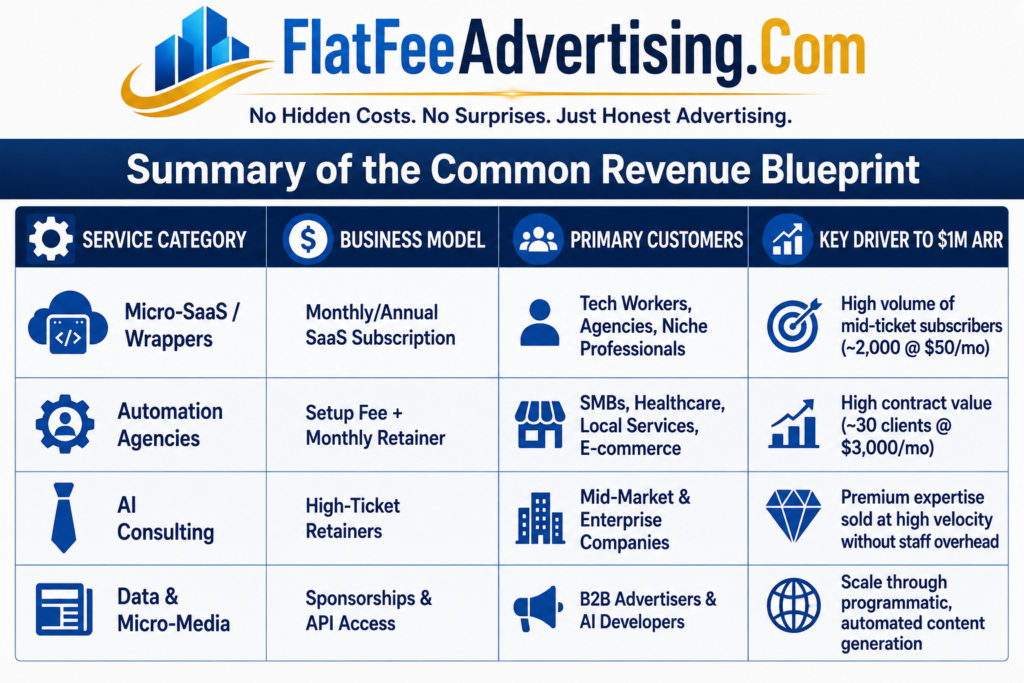
The primary categories of services and products these solo founders offer to achieve $1M+ in annual revenue include:
- Vertical Micro-SaaS & Specialized Prompt Tools
Instead of competing with multi-purpose tools like ChatGPT or Anthropic’s Claude, solo founders build hyper-focused software tailored to specific professions. These tools sit on top of frontier AI models via APIs (often termed “AI wrappers”), but add domain-specific UI, tailored integrations, and fine-tuned system instructions.
Product Requirement & Technical Spec Generators:
Example: ChatPRD (built by tech executive Claire Vo) acts as an AI product manager. It helps product leads draft, review, and refine complex Product Requirement Documents (PRDs) in seconds.
Revenue Model: B2B software-as-a-service (SaaS) charging $20–$100+/month per seat.
Specialized Document Assistants: AI assistants fine-tuned for niche industries—such as generating legal contract initial drafts, converting medical transcripts into compliant clinical notes, or writing real estate listing copy synced directly to Multiple Listing Services (MLS).
Why it hits $1M: Low churn and high willingness to pay. A tool that saves a product manager or lawyer 5 hours a week easily justifies a $500–$1,000 annual corporate subscription. With minimal hosting costs, acquiring 1,000 to 2,000 users reaches the $1 million mark. - AI Automation Agencies (AAAs) & Workflow Orchestration
Many solo operators achieve $1M+ revenue by acting as one-person tech integrators for traditional businesses that lack internal software development capabilities.
Niche Business Process Automation:
Service: Connecting legacy software systems (CRMs, scheduling software, inventory databases) to AI agents using automation tools (like Make, Zapier, or custom Python scripts).
Examples: Automated patient intake and reminder sequences for dental clinics, automated invoice processing for logistics firms, or instant inbound lead qualification for real estate agencies.
AI Agent Platforms:
Example: Polsia (built by founder Ben Broca) provides infrastructure that resells and orchestrates AI agent services, enabling non-technical users to set up automated digital storefronts and tasks.
Why it hits $1M: High upfront implementation fees ($5,000–$25,000 per project) paired with recurring monthly maintenance retainers ($1,000–$3,000/month). A solo founder needs only 30–40 active enterprise clients to reach a seven-figure run rate. - AI-Accelerated Strategic Consulting & Advisory
Consultants who historically capped their income due to hourly time constraints are using AI to scale output without taking on employees.
Implementation Advisory: Founders like Troy Johnston offer consulting services to help non-tech executives integrate AI into their sales and operations pipelines.
Specialized Financial & Legal Modeling: Single operators provide institutional-grade financial modeling, pitch deck creation, or tax strategy. AI handles data ingestion, spreadsheet formula generation, and initial reporting, allowing the founder to complete work that used to take an entire team of junior analysts in a fraction of the time.
Why it hits $1M: Because the founder retains 100% of the agency fee rather than distributing revenue across a 10-person team of analysts or associates, they can bill $80,000–$100,000 per month across a handful of enterprise clients. - High-Yield Micro-Media, Data Curation & Digital Marketplaces
Solo creators build high-margin digital media assets and specialized data pipelines.
Programmatic SEO & Content Systems: Niche media brands that leverage AI to aggregate, summarize, and distribute industry-specific data (e.g., job boards for specialized industries, regulatory updates, or financial news summaries).
Training Data & Annotation Pipelines: Providing curated, high-quality domain-specific datasets to mid-sized AI labs and enterprise software firms for model fine-tuning.
Digital Tool Marketplaces: Platforms that host, sell, and license specialized prompts, custom GPTs, or workflow templates.
Why it hits $1M: Near-100% gross profit margins. These businesses monetize through high-tier B2B sponsorships, premium subscription paywalls, and API access fees.
The Structural Emergence of the Solopreneur Super-App
The traditional lifecycle of a technology startup has long been governed by a familiar paradox: to build a scalable product, a founder must scale a human organization. Historically, going from an initial prototype to a enterprise-grade software solution required recruiting specialized talent—chief technology officers, front-end and back-end engineers, product designers, customer support representatives, and growth marketers. Each addition to the organizational chart brought payroll burden, management overhead, equity dilution, and communication friction.
The rise of high-capability artificial intelligence platforms, autonomous agentic frameworks, and integrated cloud infrastructures has fundamentally disrupted this math. As detailed in The Wall Street Journal’s analysis, we are witnessing the birth of the high-leverage, non-employing startup: enterprises capable of generating seven- or eight-figure annual recurring revenue (ARR) with a single human sitting at the apex of the operations chain.
This phenomenon is not merely an incremental improvement in software productivity. It represents a paradigm shift in firm theory. In Ronald Coase’s foundational 1937 work, The Nature of the Firm, businesses exist because the internal transaction costs of organizing production within a management hierarchy are lower than the external transaction costs of contracting every task out on the open market. Generative AI dramatically collapses both internal coordination costs and external execution friction, effectively shifting the optimal firm size down to a single decision-maker.
Software Engineering and Product Development
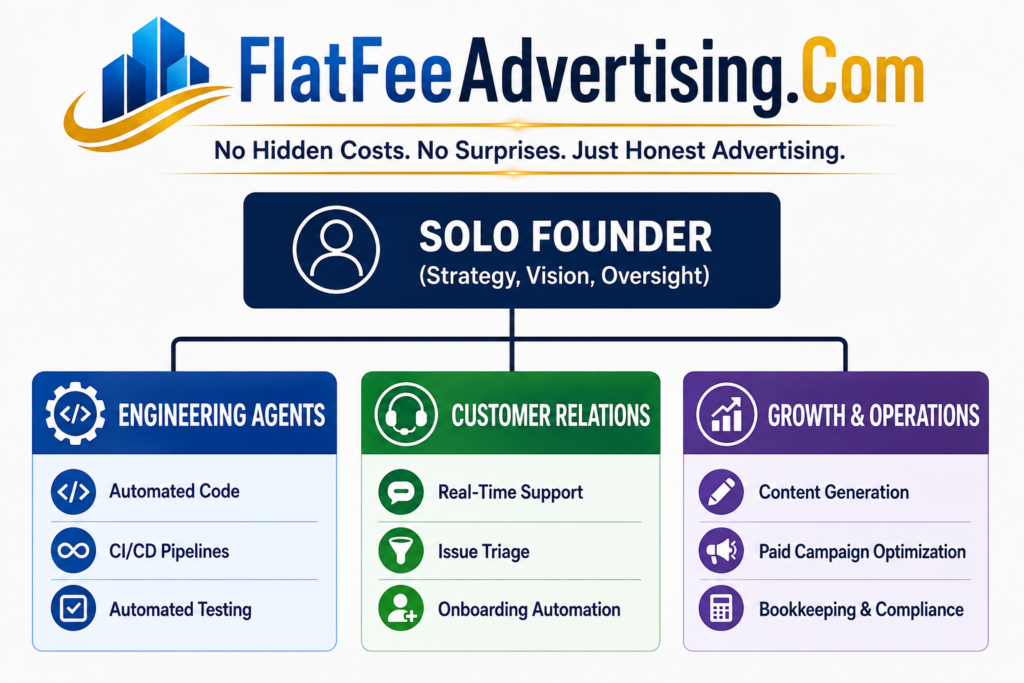
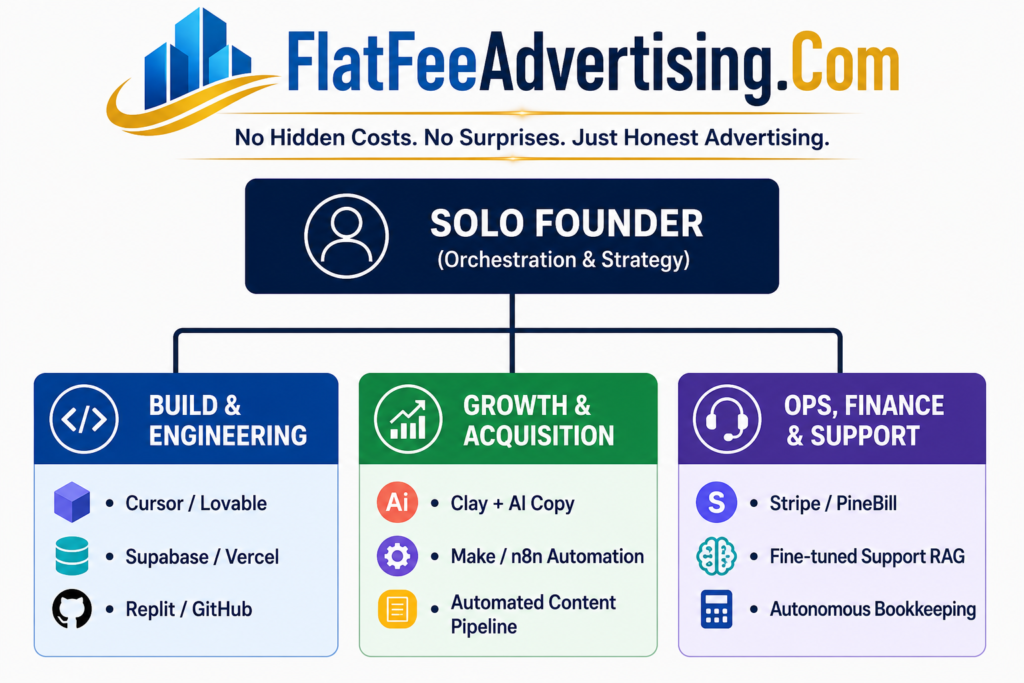
In conventional tech ventures, software engineering represents the highest capital expenditure. Today, a single founder uses advanced coding assistants and autonomous developer agents (such as GitHub Copilot, Cursor, and Devin-style frameworks) as force multipliers.
Rapid Prototyping: Founders prompt LLMs to write boilerplate code, build database schemas, and create responsive UI components in minutes.
Refactoring and Testing: AI agents automatically generate unit tests, identify security vulnerabilities, and rewrite legacy functions for performance optimization.
Continuous Integration/Continuous Deployment (CI/CD): Infrastructure provisioning, container orchestration via Docker or Kubernetes, and cloud deployment pipelines are managed through conversational interfaces or pre-configured agentic scripts, eliminating the need for a dedicated DevOps team.
Customer Acquisition, Support, and Retention
Customer service usually scales linearly with user growth—more users require more support reps. Solo startups break this linear relationship by using retrieval-augmented generation (RAG) system architectures connected to their product documentation and backend database logs.
Automated Support: AI agents handle up to 90% of user inquiries in real time, resolving account issues, troubleshooting technical bugs, and processing refunds without human intervention.
Hyper-Personalized Marketing: Algorithmic systems generate tailored ad copy, write targeted outbound emails based on user telemetry, and optimize ad spend across digital networks using real-time predictive analytics.
Finance, Compliance, and Back-Office Operations
Administrative tasks that used to consume significant operational attention are now offloaded to specialized AI integrations.
Accounting: Automated ledgers categorize expenses, reconcile transactions via Stripe or banking APIs, and predict tax liabilities.
Legal and Contracts: LLMs review terms of service agreements, flag unusual vendor contract clauses, and generate standard enterprise agreements, leaving only final approval for external legal counsel.
Final Thoughts
The Wall Street Journal’s coverage of AI-powered, one-person businesses makes one thing abundantly clear: today’s entrepreneurs can achieve extraordinary growth with far fewer people and far lower operating costs than ever before. But building a lean company isn’t just about using AI—it’s about eliminating unnecessary expenses across every aspect of your business. That’s why choosing a transparent, flat-fee advertising partner can make such a difference. Instead of watching agency fees increase alongside your ad budget, you keep more of your hard-earned revenue to reinvest in growth. In the AI era, controlling costs isn’t just smart—it’s a genuine competitive advantage.