
Most business owners view the word “FREE” as a dirty word.
They associate “free” with cheapness, desperation, freebie-seekers, and wasted operational costs. They build a website, put up a banner that screams “REQUEST A QUOTE” or “BOOK A CALL,” and then wonder why 98% of their web traffic leaves without giving them a single penny.
Here is the cold, hard reality of modern marketing: Nobody wants to request your quote. When you ask a prospect to book a call or request a quote the moment they discover you, you are asking for a massive commitment before offering a single drop of value. You are pitching to the absolute top sliver of the market—the tiny fraction of buyers who are warm, ready, and desperate to buy right now. In doing so, you surrender the massive majority of the market to your competitors.
To scale a business, capture thousands of leads, and dominate your niche, you must master the mechanics of value-first leverage. You don’t make money by hiding your value behind a paywall; you make money by using the irresistible pull of “FREE” to engineer total market dominance.
- Shift the Objective: Pay with Time Before Paying with Money
When a prospect lands on your page, your primary goal isn’t to take their money immediately—it is to capture their contact information in exchange for lower-barrier action.
Think of it as a transaction of attention. When someone pays with their time first, they become exponentially more likely to pay with their money later.
Imagine you have 100 cold prospects walk past your store:
The “Buy My Stuff” Approach: You yell at all 100 people, “Buy my $2,000 package right now!” Maybe 1 person buys. You made one sale, but 99 people walked away, and you have zero way to contact them ever again.
The “Power of Free” Approach: You tell those same 100 people, “Hey, you don’t have to buy anything. Let me solve this one quick problem for you right now for free.” 30 people accept. You deliver incredible value. Afterwards, you say, “Now that we solved that, would you like us to fix the rest?” If even 10% of those leads convert, you get 3 sales instead of 1.
You didn’t spend a single extra dollar on traffic or advertising. You simply increased your conversion rate by softening the front-end ask and building a bridge of trust.
- The 3 Types of Free Offers That Convert
A bad lead magnet gets ignored. A great lead magnet solves a specific, narrow problem so effectively that it naturally creates a new desire for your core product.
As Alex Hormozi outlines, there are three proven categories of high-converting free offers:
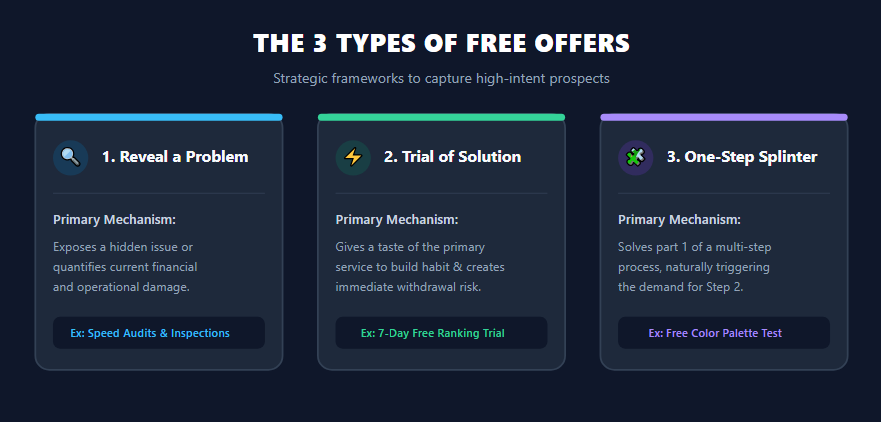
Type 1: Reveal a Problem (The Audit / Assessment)
This strategy works by increasing the prospect's awareness of a gap between where they are and where they should be. It triggers what Hormozi calls deprivation.
Example: A website speed test. A business owner runs a free 10-second audit and learns their site takes 8 seconds to load, costing them 18% of their revenue. They didn’t know they had a problem, but now that they see it, they urgently need your core service to fix it.
Best for: Termite inspections, posture analyses, tax audits, or agency performance teardowns.
Type 2: A Trial of the Solution (The Sampler)
This is the classic “Costco Sample” or “Try Before You Buy” model. You give prospects access to a limited version of your actual product or service so they can sample its effectiveness.
Example: A local SEO agency ranks a client in the top 3 spots of Google Maps for 7 days completely free. At the end of 7 days, they call the business owner and say, “Your trial is over. Do you want us to turn it off, or keep the leads flowing?” * Why it works: Removing the solution creates instant withdrawal. Taking away what they just experienced drives higher back-end conversion.
Type 3: One-Step of Multi-Step (The Splinter Offer)
Complex problems require multiple steps to solve. Pull out the very first step of your core service, turn it into a high-value freebie, and deliver it turn-key.
Example: A fashion stylist offers a free 5-minute custom color-palette assessment. Once the client receives their perfect color scheme, their very next question is: “Great, but what tops, bottoms, and jackets should I actually buy?” * The free offer solved Problem A, but instantly created Problem B—which your paid core offer solves.
- The 4 Delivery Vehicles for “FREE”
How you deliver your free offer dictates how high its perceived value will be. You can deliver free assets across four distinct channels:
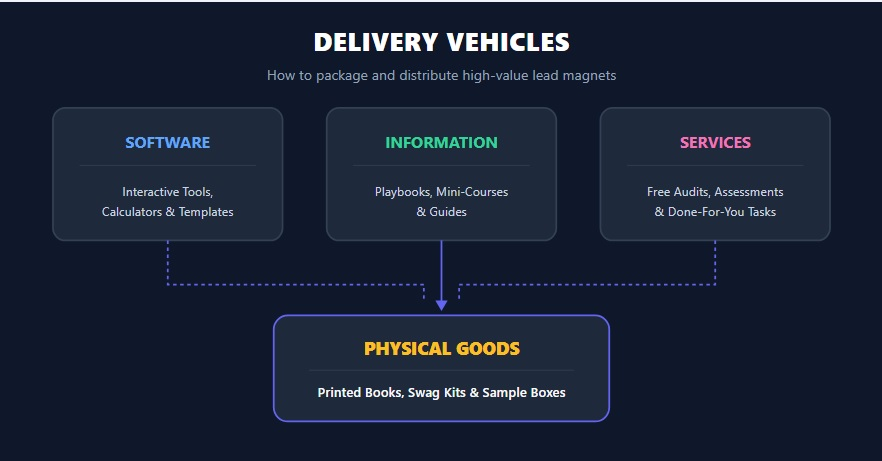
Tools & Software: Spreadsheets, interactive calculators, diagnostic apps, or automated templates. These carry high perceived utility because they do work for the user.
Information Assets: Playbooks, case studies, cheat sheets, or mini-courses. Rule of thumb: Give away information that others charge for. Make the content so good that people feel guilty they got it for free.
Free Services: Audits, free strategy sessions, or small done-for-you tasks. Doing free work for qualified prospects is one of the fastest ways to build goodwill and close high-ticket deals.
Physical Products: Books, sample boxes, or specialized gear. Sending physical items directly to a prospect’s door commands immediate attention and elevated trust.
- Overcoming the “Freebie Seeker” Myth
The most common objection to using free offers is: “I don’t want tire-kickers and cheap people wasting my time.”
If you are getting bad leads from free offers, you don’t have a lead magnet problem—you have a qualification problem.
You control who gets access to your free offer. If you run a high-ticket B2B service, don’t give away your free audit to everyone. Add a simple 3-question qualification form on your landing page.
Filter for:
Budget: Do they generate over a certain revenue threshold?
Authority: Are they the primary decision-maker?
Urgency: Are they ready to take action in the next 30 days?
If they qualify, route them directly to your premium free service or custom report. If they don’t, automatically redirect them to a self-serve piece of content. You reserve your highest-friction free assets (like free services or physical gifts) strictly for dream prospects.
- Engineer Offers on the 3 Vectors of Value
Once your lead magnet has captured attention and earned trust, your core offer must be structured so that saying “No” feels stupid.
When your core service is hard to differentiate from competitors, do not compete on price. Instead, win on the Three Vectors of Value:
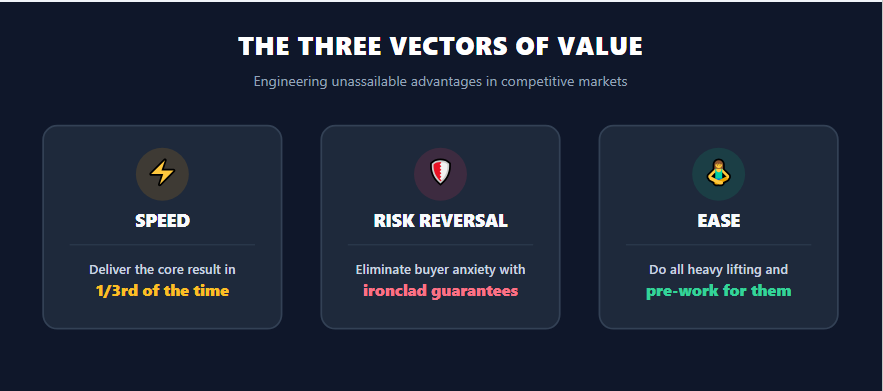
Get the result in Eliminate fear with Do the heavy lifting
1/3rd the time. ironclad guarantees. and pre-work for them.
Vector 1: Speed
Ask yourself: “What would it take for us to get this exact outcome for our client in one-third of the time?” If standard competitors take 30 days to deliver, engineer your internal systems to deliver in 48 hours. Charge a premium price for that speed.
Vector 2: Risk Reversal
Identify your customer’s biggest fear (e.g., “What if this doesn’t work?” or “What if my property gets damaged?”) and insure against it. Offer bold performance guarantees or back your service with insurance policies. When you remove the risk from the buyer and place it on yourself, sales friction disappears.
Vector 3: Ease
How much pre-work can you complete before the client even signs? If you handle intake, onboarding, setup, and logistics for them, you turn a complex process into a simple turn-key experience.
- How to Package & Name Your Free Asset
Packaging dictates consumption. You can double or triple your lead capture rate simply by changing the headline of your free offer without altering a single page of the content inside.
Stop naming your lead magnets after the process. Name them after the dream outcome.
High-Converting Naming Formulas:
The Number + Outcome + Timeframe: “3 Email Templates That Turn Cold Leads into Clients in 24 Hours”
How to [Yay] Without [Boo]: “How to Build a High-Converting Funnel Without Hiring an Expensive Copywriter”
The Error/Mistake Framework: “5 Ad Copy Mistakes That Are Silently Killing Your Conversion Rates”
Test your titles. Poll your audience, run low-budget ad split tests, or send quick text messages to past clients to see which headline creates the strongest emotional pull.
- The Monetization Formula: Embed the Call to Action
A free asset without a clear next step is just charity. Every piece of free value you distribute must feature an explicit, unambiguous Call to Action (CTA).
Your CTA framework needs three core elements:
Be Direct and Clear: Tell the prospect the exact physical step to take next. Avoid overly clever phrasing; use direct commands (e.g., “Click the button below to schedule your setup session”).
Define the Immediate Next Action: Clarify what happens right after they click so there is zero confusion or anxiety.
Provide a Reason to Act NOW: Use authentic urgency or scarcity.
If you run a service business, leverage your natural operational limits: “We only have capacity to onboard 3 new clients this week. Once those slots fill, our calendar closes until next month.”
Free Is the Ultimate Growth Engine
“Free” is not about giving away your business; it is about buying the attention, trust, and goodwill of your target market before your competitors even know they exist.
By leading with value, structuring low-barrier entry points, solving real problems upfront, and pitching premium offers backed by speed, ease, and guarantees, you transform cold traffic into a steady stream of loyal, high-paying clients.
Stop asking for the sale on the first date. Give value first, demonstrate proof, and let the power of free fuel your growth.
The Advice from Alex Hormozi.
In the video, Alex suggests taking one component out of your main offer and giving it away for FREE. Or reduce it by 80–90% and use it as a lead-in to upsell your full package.
Thank you, Alex – We decided to do Both!
- At this link, you can get a sample of one of our Weekly Lead Reports for FREE.
- At this link, you can access the Insider Contact Toolkit (which eliminates the need for cold calling or cold emailing) for a huge discount of 90% (As we get full of requests, we won’t be offering this price for long).