The modern insurance landscape is a battlefield of digital noise. Every day, independent agents and agency owners log into their dashboards with a singular, exhausting obsession: customer acquisition. For years, the prescribed gospel of the insurance industry has been clear: you must build a brand on social media, you must dump a fortune into Pay-Per-Click (PPC) advertising on Google and Meta, and you must sacrifice years of your life and thousands of dollars to the capricious gods of Search Engine Optimization (SEO).
Yet, for thousands of hardworking agents, this traditional digital playbook delivers a bitter return on investment. Budgets bleed dry on expensive clicks from tire-kickers who never pick up the phone. Months turn into years while waiting for organic search rankings that shift every time Google updates its core algorithm. And the relentless treadmill of creating social media content—reels, carousels, and thought-leadership posts—often yields vanity metrics rather than signed policies.
What if there is a better way? What if you could bypass the algorithmic gatekeepers entirely, reclaim your time, stop lighting money on fire through ad auctions, and consistently secure high-intent insurance clients? This comprehensive guide explores how independent insurance agents can sustainably grow their books of business without ever touching social media, PPC, or SEO, and positions a smarter, streamlined alternative: tapping into early-stage market access through strategic platforms like Flat Fee Advertising.
The Digital Marketing Trap: Why Traditional Channels Bleed Budgets
To understand why breaking away from traditional channels is so liberating, we must first dissect the hidden costs of the holy trinity of digital marketing: PPC, SEO, and Social Media. On paper, these strategies sound logical. In practice, they are financial funnels designed to extract maximum revenue from small businesses while favoring massive, venture-backed aggregators and national carriers.
The PPC Profit Squeeze: Paying for Clicks, Not Clients
Pay-Per-Click advertising—whether through Google Ads, Microsoft Advertising, or Meta platforms—operates on an auction model. In high-intent niches like insurance, competition is fierce. Keywords such as “auto insurance quote,” “commercial liability insurance,” or “whole life insurance policies” command astronomical Cost-Per-Click (CPC) figures, often ranging from $20 to over $100 per click depending on the zip code and vertical.
Consider the basic math of a traditional PPC campaign for an independent property and casualty (P&C) agency:
- Monthly Ad Spend: $3,000
- Average Cost Per Click (CPC): $30
- Total Clicks Generated: $100 visitors
- Landing Page Conversion Rate (Lead Capture): $10 leads
- Close Rate (Quote to Policy): $20 ($2 closed policies)
- Average Commission per Policy: $400
- Total Revenue Generated: $800
In this realistic scenario, the agency spent $3,000 to generate $800 in revenue, resulting in a net loss of $200. Worse yet, these leads are rarely exclusive. They are often comparison shoppers filling out forms on multiple aggregator sites simultaneously, racing to the bottom on price. By the time your phone rings, they have already spoken to three other agents. You are not selling value; you are bidding in a commodity race.
The SEO Mirage: Waiting for a Miracle That Might Never Come
Search Engine Optimization is routinely sold as the “free” alternative to PPC. Agencies are told that once they rank #1 for local insurance keywords, an endless stream of inbound prospects will flow through their virtual doors.
The reality is starkly different. SEO is a marathon with a moving finish line.
- High Barrier to Entry: You are competing against multi-billion-dollar aggregators (like Progressive, Geico, NerdWallet, and Bankrate) who dominate local and national search engine results pages (SERPs) with endless arrays of optimized content and domain authority.
- Time Horizon: Achieving meaningful, revenue-generating organic rankings can take anywhere from 12 to 36 months of relentless content creation, link building, and technical site maintenance.
- Algorithm Volatility: A single Google algorithm update can wipe out years of hard-earned rankings overnight, dropping your agency from page one to obscurity without warning.
For an insurance agent who needs to write policies this month to make payroll and cover overhead, telling them to wait two years for SEO to kick in is financial malpractice.
The Social Media Treadmill: Vanity Metrics vs. Closed Policies
Platforms like LinkedIn, Facebook, Instagram, and TikTok promise community engagement and brand awareness. Agents are encouraged to post daily tips on risk management, explain deductible structures, or record entertaining reels about life insurance.
The core problem with social media for insurance is consumer psychology. People do not wake up scrolling through Instagram thinking, “I really want to review my commercial umbrella policy today.” Insurance is a grudge purchase—a financial safeguard bought out of necessity or legal requirement.
While social media can help reinforce an existing brand, using it as a primary client acquisition engine is deeply inefficient. You spend hours scripting, filming, editing, and replying to comments, only to find that your engagement consists mostly of other insurance agents liking your posts, rather than local business owners or families looking for coverage.
Shifting the Paradigm: What It Means to “Reach Them First”
If PPC is too expensive, SEO is too slow, and social media is a distraction, where does growth come from? The answer lies in timing and positioning.
Traditional marketing operates on an interruptive model: you shout into a crowd, hoping someone happens to be listening at the exact moment you are speaking. Strategic client acquisition, by contrast, focuses on identifying and reaching prospects at the precise inflection point when their need for insurance changes, before they enter the chaotic digital marketplace to shop around.
The Lifecycle of an Insurance Buyer
Every insurance client goes through a predictable lifecycle of triggers. For example:
- Commercial Lines: A new business registers its LLC, secures commercial real estate, or hires its first employees. At this exact moment, they legally require general liability or workers’ compensation insurance.
- Homeowners Insurance: A real estate transaction moves from “pending” to “under contract.” The lender mandates hazard insurance before clearing the mortgage to close.
- Life Insurance: A major life event occurs—marriage, the birth of a child, purchasing a home, or starting a business—instantly creating a vulnerability that demands income protection.
When you intercept prospects at these foundational trigger points, the dynamics of the sale change completely. You are no longer fighting for scraps in a crowded digital auction. You are arriving precisely when the need is acute, establishing immediate relevance and trust.
Deconstructing the Alternative: A Closer Look at Flat Fee Advertising
To break free from the performance-punishing models of PPC, SEO, and social media, innovative insurance agents are turning toward structured, predictable outreach models. A prime example of this philosophy is found through services like Flat Fee Advertising, which bypasses the variable cost traps of traditional digital marketing.
The Economics of Flat-Fee vs. Variable-Cost Models
When evaluating marketing investments, predictability is every bit as important as ROI.
- The PPC Variable Trap: In a standard PPC campaign, if demand spikes or a competitor drives up your CPC, your customer acquisition cost skyrockets. Success punishes you with higher ad bills.
- The Flat-Fee Advantage: Flat-fee models decouple your costs from auction inflation. You know exactly what your marketing investment will be each month, allowing you to accurately calculate your cost-per-acquisition and maintain strict control over profit margins.
Eliminating Wasteful Intermediaries
Traditional lead generation companies often act like digital tollbooths. They buy cheap traffic, package it into generic leads, and sell the same lead to four or five different agents. The winner is whoever dials the phone first—often leading to aggressive, transactional phone sales that damage your agency’s brand reputation.
A streamlined approach focuses on direct connection without the middlemen inflating costs or diluting lead exclusivity. By positioning your agency in front of active buyers through targeted, direct channels, you preserve your margins and speak to prospects who are genuinely accessible.
Step-by-Step Blueprint: Building an Agency Pipeline Without Social Media, PPC, or SEO
Transitioning away from the digital marketing hamster wheel requires discipline and a pivot toward proactive, systematic outreach. Here is how you can build a thriving insurance book of business using alternative, high-efficiency strategies.
Step 1: Establish Direct Referral Ecosystems
The highest-converting, lowest-cost insurance clients come through trusted word-of-mouth and professional partnerships. Instead of spending money trying to convince strangers online, invest your energy in building alliances with professionals who encounter your ideal clients before they need insurance.
- For P&C and Commercial Agents: Forge relationships with commercial real estate brokers, residential mortgage lenders, payroll processing companies, and local business attorneys. When a new business incorporates or buys a building, these partners are the first to know.
- For Life and Health Agents: Partner with estate planning attorneys, local accountants (CPAs), and financial advisors. Financial planners look at wealth accumulation; you protect that wealth from catastrophic loss.
Step 2: Leverage Early-Stage Public Records and Data Triggers
Public records are a goldmine for independent agents who know how to read them. Across every county and state, public filings constantly reveal commercial entity formations, real estate transfers, and professional licensing changes.
Instead of waiting for someone to type “business insurance near me” into Google (where they will see ten sponsored ads and three massive aggregator sites), you can utilize structured data services and proactive outreach platforms—such as those specialized in early-stage market positioning—to get your agency’s information directly into the hands of decision-makers the moment they enter the market.
Step 3: Implement Direct Mail and Direct Outreach That Converts
While digital inboxes are flooded with spam and social feeds are ignored, physical mailboxes and direct phone/email outreach to targeted lists still carry significant weight, provided the messaging is hyper-relevant.
- The Power of Relevance: A generic postcard saying “Call us for your insurance needs” goes straight to the trash. A tailored letter to a newly registered local business stating, “Congratulations on launching your LLC in [City Name]—here is a checklist of the exact liability coverages required for your industry” commands immediate attention.
- Combining Channels: Use flat-fee directories or targeted data feeds to identify new market entrants, then deploy a simple, high-impact direct touch sequence.
Comparing the Approaches: Time, Money, and Sanity
Let us put traditional marketing channels side-by-side against a streamlined, non-PPC/SEO/social approach to see how they truly measure up across three critical dimensions: financial investment, time commitment, and psychological toll.
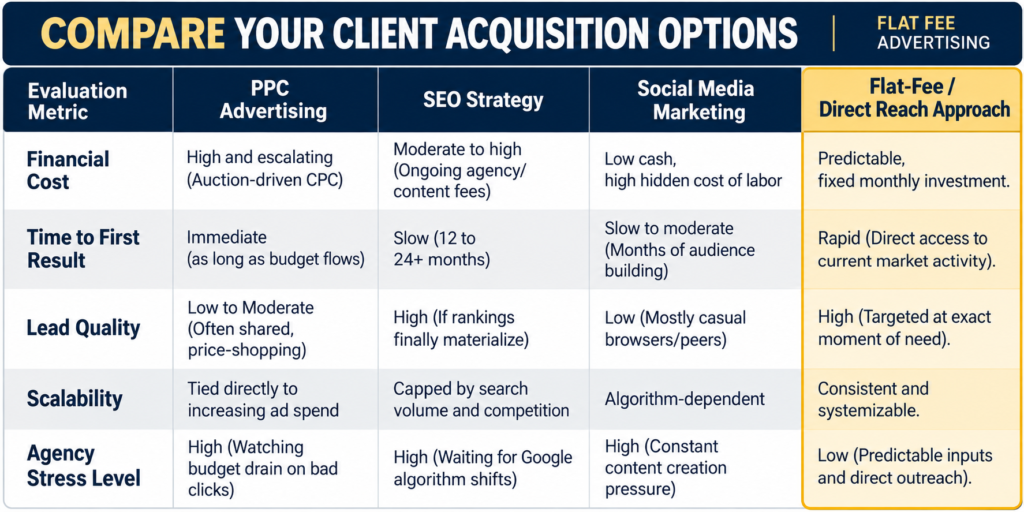
As this comparison illustrates, sticking to the conventional digital playbook forces agents into a high-stress, low-margin cycle. Moving away from ad auctions and algorithm chasing frees up capital to reinvest directly into client retention and agency growth.
Overcoming Skepticism: Can You Really Grow Without Digital Ads?
Many agency owners suffer from digital marketing conditioning. They have been told for so long that “if you aren’t on Google and Facebook, you don’t exist,” that stepping away feels terrifying.
To overcome this hesitation, ask yourself a fundamental question: How did insurance agencies build massive, multi-million-dollar books of business before Google and Facebook existed?
They did it through relationships, positioning, being present where decisions were made, and reaching prospects efficiently before competitors could intercept them. The internet has not changed human psychology; it has simply cluttered the landscape with expensive middlemen selling digital noise.
By utilizing structured, flat-fee acquisition services like Flat Fee Advertising, you cut through the digital clutter. You stop renting attention from tech giants who raise their prices every quarter, and instead invest in predictable, direct pathways to real clients.
Action Plan for Independent Agents: Your Next 30 Days
If you are ready to stop wasting time on social media algorithms and stop burning cash on PPC auctions, here is a practical 30-day roadmap to transition your agency’s growth engine:
- Audit Your Current Acquisition Costs: Calculate your exact Customer Acquisition Cost (CAC) across your current PPC, SEO, and social channels over the past 12 months. Factor in not just ad spend, but agency management fees and the hours spent creating content.
- Reallocate Your Budget: Cut underperforming ad campaigns that rely on shared, low-intent digital leads. Reallocate a portion of that predictable budget into streamlined, flat-fee early-reach services designed to put your agency in front of un-jaded prospects.
- Build Outreach Templates: Draft clear, value-driven introductory letters or emails tailored specifically to new market entrants (new homeowners, newly incorporated businesses, expanding enterprises). Focus on education and protection rather than a hard sales pitch.
- Establish Strategic Partnerships: Schedule coffee meetings or video calls with at least three local professionals (mortgage brokers, CPAs, commercial real estate agents) to establish mutual referral pipelines.
- Track and Refine: Measure the conversion rate of your direct, non-PPC outreach over 30 days. Compare the quality of conversations, close rates, and average policy premiums against your historical digital lead metrics.
Conclusion: Take Back Control of Your Agency’s Growth
The insurance industry rewards agents who work smarter, not just harder. For too long, independent agency owners have accepted the high costs, algorithm anxiety, and diminishing returns of PPC, SEO, and social media as the “cost of doing business” in the digital age.
They are not. They are simply options—and often, they are the most expensive, least efficient options available.
You can save your sanity, protect your profit margins, and most importantly, reach your ideal insurance clients right when they need you most—before your competitors even know they exist.
Click here to see if your zip code is available to get new clients without wasting time on social media, paying for expensive PPC or even using SEO.